
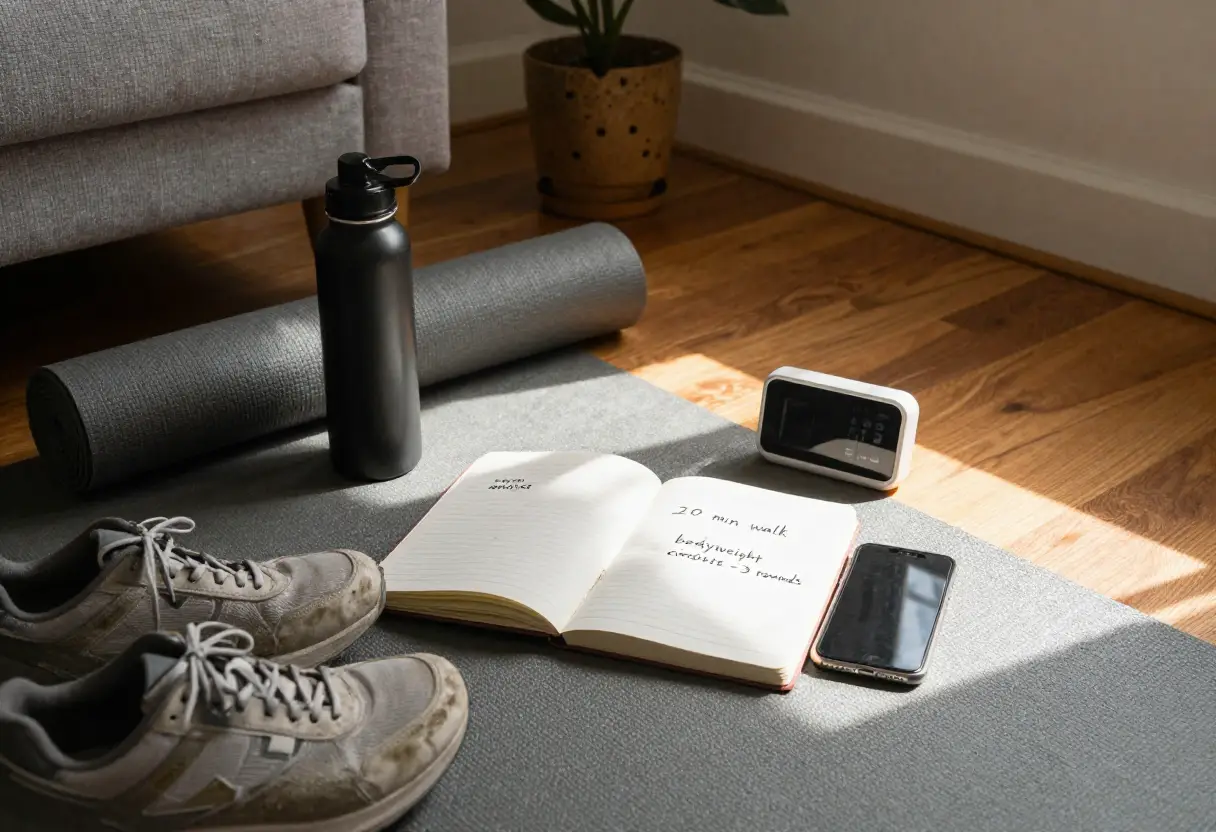
Let’s be honest for a second. Your camera roll probably has a screenshot of a savage-looking 6-day gym split you saved “for later.” Your browser history might include a frantic 2 a.m. search for “best ab workout.” And if you’re anything like I was a decade ago, you’ve probably launched yourself into a punishing routine only to feel sore, discouraged, and burnt out within three weeks.
We’ve all been there. The problem isn’t a lack of effort; it’s that we start with the what (the exercises) before establishing the how (the sustainable structure). We try to copy an advanced athlete’s recipe before we’ve even learned how to turn on the stove.
This guide is different. Think of me as your slightly-more-experienced friend who’s made all the mistakes so you don’t have to. We’re not just building a workout schedule; we’re building a ritual that fits into your life, respects your energy, and actually makes you feel better. No jargon, no intimidation—just a clear, compassionate blueprint.
Step 1: The Mindset Shift – From Punishment to Partnership
Before we touch a single exercise, we need to reframe what “working out” even means. If your internal monologue sounds like, “Ugh, I have to go burn off that pizza,” you’ve already lost. That’s a chore. Chores get procrastinated.
Instead, I want you to view this new routine as the most reliable 30-minute meeting you have all day—a meeting with your future self. It’s not about punishing your body for what it is; it’s about partnering with it to see what it can become. This is the non-negotiable foundation. Every time you lace up your shoes, you’re voting for the person you want to be.
Step 2: The Anatomy of a Doable Plan (The FITT Principle, Decoded)
Fitness pros love acronyms, and FITT is a good one: Frequency, Intensity, Time, and Type. It sounds technical, but let’s translate it into human terms.
-
Frequency: 2-3 days per week. Not 6. Not 7. Two or three. Consistency with two days is a million times better than a heroic, unsustainable five-day streak followed by a month of nothing. Your body adapts and heals on rest days. They are part of the program.
-
Intensity: The “Talk Test.” You should be able to say a short sentence, but not sing the chorus of your favorite song. If you’re gasping, you’ve gone too hard too soon. If you can have a full philosophical debate, you can push a little more. We’re aiming for a 6 or 7 out of 10 on your personal effort scale.
-
Time: 20-40 minutes. The perfect workout is not the longest one; it’s the one you complete. A focused, 25-minute session beats a distracted, 60-minute one every time. Set a timer. When it goes off, you’re done. This builds trust with yourself.
-
Type: The Move-Your-Body Trinity. Each week, aim to touch on these three categories:
-
Strength: Using resistance (bodyweight, dumbbells, bands) to build muscle.
-
Cardio: Getting your heart rate up (brisk walking, cycling, dancing).
-
Mobility: Actively caring for your joints and muscles (dynamic stretching, yoga flows).
-
Step 3: Crafting Your Weekly Schedule (The “Where Does This Actually Fit?” Part)
This is where most plans fall apart. We schedule a 6 a.m. workout when we’re a certified night owl. Be a ruthless realist about your life.
-
Audit Your Week: Grab your phone’s calendar or a plain old notebook. Block out your unmovable commitments: work, school, childcare, etc.
-
Find Your Energy Windows: When do you naturally feel a lift? For some, it’s first thing before the day’s clutter sets in. For others (like me), it’s right after work to decompress. There is no morally superior time to exercise. The best time is the one you’ll consistently do.
-
Pencil It In, Literally: In those open windows, write “MEETING WITH MY FUTURE SELF” or simply “MOVEMENT.” Treat it with the same respect as a doctor’s appointment.
A Sample “Real Life” Beginner Week:
-
Monday: 30-Minute Full Body Strength (at home)
-
Tuesday: Rest or 20-Minute Gentle Walk
-
Wednesday: 25-Minute Cardio (brisk walk/jog, dance video, bike ride)
-
Thursday: Rest
-
Friday: 30-Minute Full Body Strength (repeat Monday, try to do a little more)
-
Saturday: Active Fun (hike, family bike ride, living room dance party)
-
Sunday: Rest & 10-Minute Mobility (focus on tight areas)
See? It breathes. It has life built into it.
Step 4: Your First Two Workouts – A No-Equipment, Anywhere Plan
Let’s put this into action. Here is a simple, full-body strength routine. Perform each exercise for 30-45 seconds, rest for 15-30 seconds, then move to the next. Complete the circuit 2-3 times.
-
Bodyweight Squats: Stand, feet shoulder-width. Send your hips back and down as if aiming for a chair. Keep your chest up. Don’t worry about depth; go as low as feels strong.
-
Incline Push-Ups: Place your hands on a sturdy table, counter, or wall. Keep your body in a straight line from head to heels and lower your chest toward the surface.
-
Glute Bridges: Lie on your back, knees bent, feet flat. Squeeze your glutes to lift your hips toward the ceiling. Hold for a second at the top.
-
Bird-Dog: On all fours, slowly extend your right arm forward and left leg back. Keep your hips level. Return and switch sides. This is magic for core stability and balance.
-
Plank (or Knee Plank): Hold the top of a push-up position (or on your knees) with your body straight. Breathe. The goal is time under tension, not suffering.
Step 5: The Tools That Actually Help (Not Just More Apps)
You don’t need fancy gear. You need simple systems.
-
Your Notes App: Log your workouts. “Did 3 rounds, squats felt easier.” This is your data. It proves progress when the scale doesn’t move.
-
A Physical Calendar: Stick it on the fridge. Put a big, satisfying ‘X’ or a gold star on every day you complete your movement. The visual chain is powerfully motivating.
-
The 10-Minute Rule: Don’t feel like it? Promise yourself just 10 minutes. 99% of the time, once you start, you’ll finish the whole thing. Momentum is everything.
The Real Talk: What to Do When It Falls Apart
You will miss a day. You’ll have a hectic week. The vacation will happen. This is not failure. This is data.
The routine didn’t break; life happened. The single most important skill in fitness isn’t a perfect squat; it’s the skill of gracefully restarting. Ask yourself kindly: “What made that hard? How can I adjust?” Maybe your evening workout gets hijacked by late meetings—so you shift it to lunch walks for that week.
Your workout routine is a path through the woods of your life. If you wander off it one day, you don’t burn down the forest. You just calmly find the path again the next day, and you keep walking.