
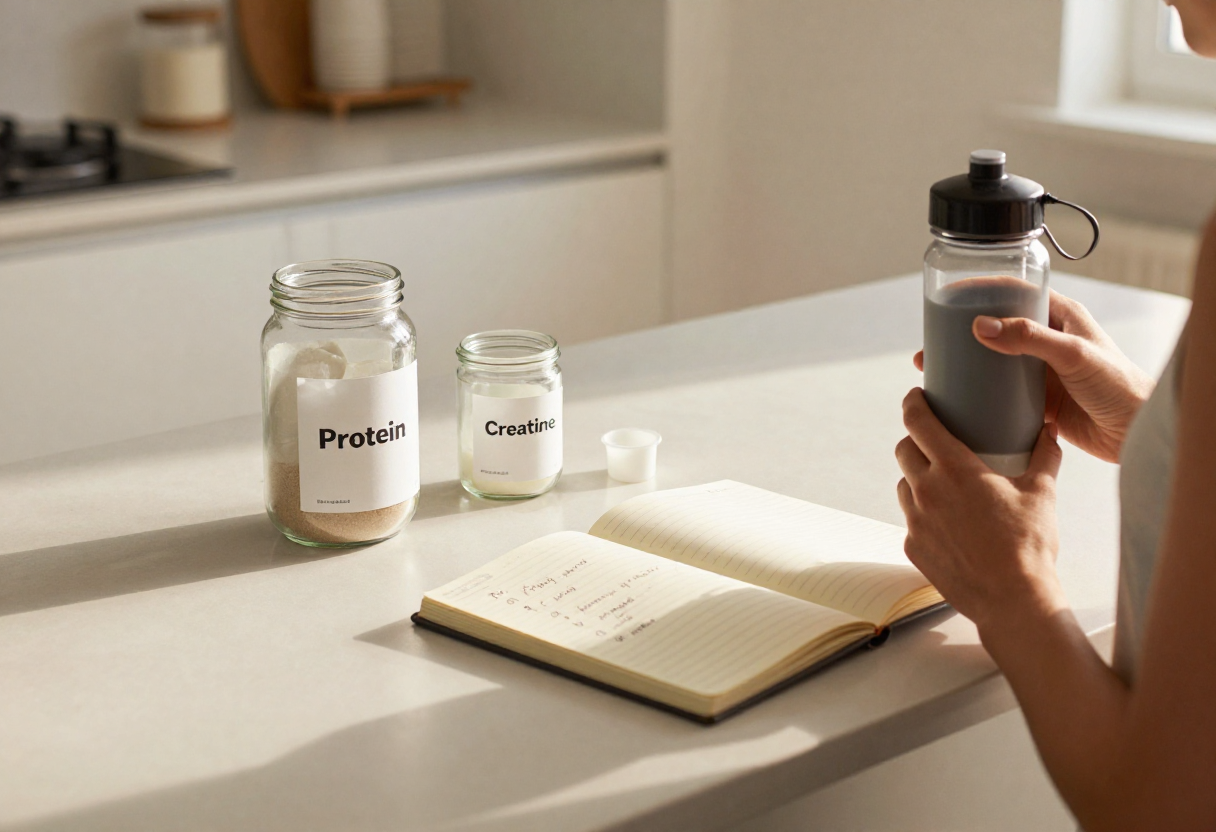
If you’ve spent any time in the health and wellness space lately, you’ve probably noticed two supplements dominating the conversation: protein powder and creatine. Walk into any gym, scroll through any fitness feed, and you’ll see endless debates about which one deserves a spot in your routine.
For women, this confusion is amplified. We’ve been told protein is essential—and it is. But creatine? That was always the “guy supplement,” right? The one for bulking up and grunting under barbells?
Here’s the truth that’s finally getting the attention it deserves: This isn’t an either-or question. Protein and creatine aren’t competitors. They’re teammates with completely different jobs. And for women, understanding how they work together might be the missing piece in your fitness and health journey.
Let’s break down what each one actually does, whether you need both, and how to decide what’s right for you.
First, Let’s Clear Up the Confusion
Before we dive into comparisons, we need to address the elephant in the room. Protein and creatine are fundamentally different things:
-
Protein is a macronutrient. It’s the physical building material your body uses to repair and build muscle tissue, plus countless other functions .
-
Creatine is a compound your body naturally produces from amino acids. It’s stored in your muscles and brain, where it helps recycle energy during short bursts of intense effort .
Think of it this way: If your muscles were a house, protein would be the bricks and lumber—the actual building materials. Creatine would be the construction crew—the energy system that helps you do the work of building .
They’re not interchangeable. They’re complementary.
What Protein Does for Women
Protein’s role is straightforward but non-negotiable. It provides the amino acids your body needs to repair muscle tissue broken down during exercise, support immune function, maintain healthy hair and skin, and keep your metabolism running efficiently .
The bottom line: Without adequate protein, your body cannot build or maintain muscle. Period.
For women, protein needs actually increase with age. As estrogen declines during perimenopause and menopause, the risk of muscle loss (sarcopenia) accelerates. Getting enough protein becomes even more critical to preserve strength, mobility, and metabolic health .
The current RDA is 0.8 grams per kilogram of body weight, but many sports nutrition experts recommend 1.2 to 1.5 grams per kilogram for active women—especially those doing resistance training .
What Creatine Does for Women
This is where things get interesting—and where recent research has flipped the script on what we thought we knew.
Creatine’s primary job is energy production. During high-intensity efforts like lifting, sprinting, or HIIT, your muscles burn through ATP (your body’s energy currency) rapidly. Creatine helps regenerate that ATP, allowing you to push harder and recover faster between efforts .
But here’s what makes creatine particularly relevant for women:
Women start with lower stores. Research shows women naturally have 70-80% lower creatine stores than men, particularly in the brain’s frontal cortex—the region responsible for mood, attention, and cognitive function . Women also consume about 30-40% less dietary creatine than men on average, since the richest sources are red meat and fish .
Hormones affect creatine metabolism. Estrogen and progesterone fluctuations throughout the menstrual cycle, pregnancy, and menopause can influence how your body synthesizes, transports, and uses creatine . This means creatine needs may shift across your lifespan in ways that don’t happen for men.
The benefits extend beyond muscle. Emerging research suggests creatine may support:
-
Bone health —particularly important as estrogen declines
-
Cognitive function —improving memory and mental fatigue resistance
-
Mood —potentially alleviating symptoms of depression
-
Sleep quality —especially in perimenopausal women
The Research: Do You Need Both?
This is the million-dollar question. If you’re already getting enough protein, does adding creatine provide extra benefit?
The research offers a nuanced answer.
A 2013 study published in the Journal of the International Society of Sports Nutrition examined exactly this question in resistance-trained women. Participants were given either whey protein alone or whey protein plus creatine after workouts during an 8-week training program .
The findings: Both groups significantly increased lean mass, strength, and power. But there were no statistical differences between the groups—the women taking both didn’t see additional gains beyond those taking protein alone .
A 2016 pilot study published by Wilborn and colleagues confirmed these results. Seventeen resistance-trained women followed a 4-day-per-week training program for eight weeks. One group took 24 grams of whey protein post-workout; the other took the same protein plus 5 grams of creatine. Both groups gained about 2.5 kilograms of lean mass. No significant differences emerged between groups .
So does this mean creatine is unnecessary if you’re already using protein?
Not exactly. Here’s what these studies don’t tell us:
First, they were conducted in young, already resistance-trained women. Results might differ for older women, vegetarians, or those just starting their fitness journey .
Second, they focused primarily on muscle and performance outcomes. They didn’t measure the cognitive, mood, or bone health benefits that may be creatine’s most valuable contributions for women .
Third, individual response varies. Some women may benefit more from creatine than others, particularly those with lower baseline stores .
The Expert Consensus: Apples and Oranges
Sports medicine physicians and dietitians are clear on this point: comparing protein and creatine is like comparing apples to oranges .
“They do different things in the body,” explains Albert Matheny, R.D., C.S.C.S., co-founder of SoHo Strength Lab. “You should have some of each” .
Jillian Chaney, R.D.N., dietitian for the Anaheim Ducks, agrees: “Both can be good. You don’t necessarily need to choose between them” .
The key is understanding what each provides and where your personal gaps lie.
Who Might Benefit Most from Adding Creatine?
While the research doesn’t show universal “extra” benefits for young, well-nourished women adding creatine to an already adequate protein intake, certain groups may see clearer advantages :
Vegetarians and vegans have significantly lower baseline creatine stores since their diets lack animal products. Supplementing may produce more noticeable improvements in both physical and cognitive performance .
Women over 50 face accelerated muscle and bone loss as estrogen declines. Creatine combined with resistance training may offer protective effects for both muscle and bone .
Perimenopausal and menopausal women may benefit from creatine’s potential effects on mood, cognition, and fatigue—all common complaints during this transition .
Women focused on cognitive health may find creatine’s brain benefits worth considering, particularly given women’s lower baseline brain creatine stores .
How to Approach Both Supplements
If you’re trying to decide where to invest your supplement budget, here’s a practical framework:
Step 1: Prioritize protein first. Protein is non-negotiable. If you’re not consistently meeting your daily protein needs through food, a protein supplement should be your first priority .
Step 2: Assess your baseline. Are you vegetarian? Over 50? Experiencing menopausal symptoms? Training for high-intensity performance? Any of these factors might increase the potential value of creatine for you .
Step 3: Consider your budget. Creatine monohydrate is inexpensive—often pennies per serving. If it fits your budget and you fall into one of the groups above, adding it is low-risk with potential upside .
Step 4: Be consistent. If you try creatine, take 3-5 grams daily, every day (including rest days). It needs to saturate your muscle stores to work, which takes time and consistency .
The Bottom Line
Protein and creatine aren’t rivals. They’re partners with different roles. Protein provides the building blocks; creatine provides the energy to use them.
For most active women, protein should be the foundation. It’s essential, well-researched, and non-negotiable for muscle health.
Creatine is optional but potentially valuable—especially for women in life stages where hormonal shifts create new demands on the body. The research supporting creatine for women’s health continues to grow, with recent studies highlighting benefits for bone density, cognitive function, mood, and metabolic wellness .
The good news? You don’t have to choose. As Matheny puts it: “Both are helpful”
The supplement aisle doesn’t have to be confusing. When you understand what each nutrient actually does, the choices become clear. Start with protein. Add creatine if it fits. And remember: supplements support a good diet—they don’t replace one.