
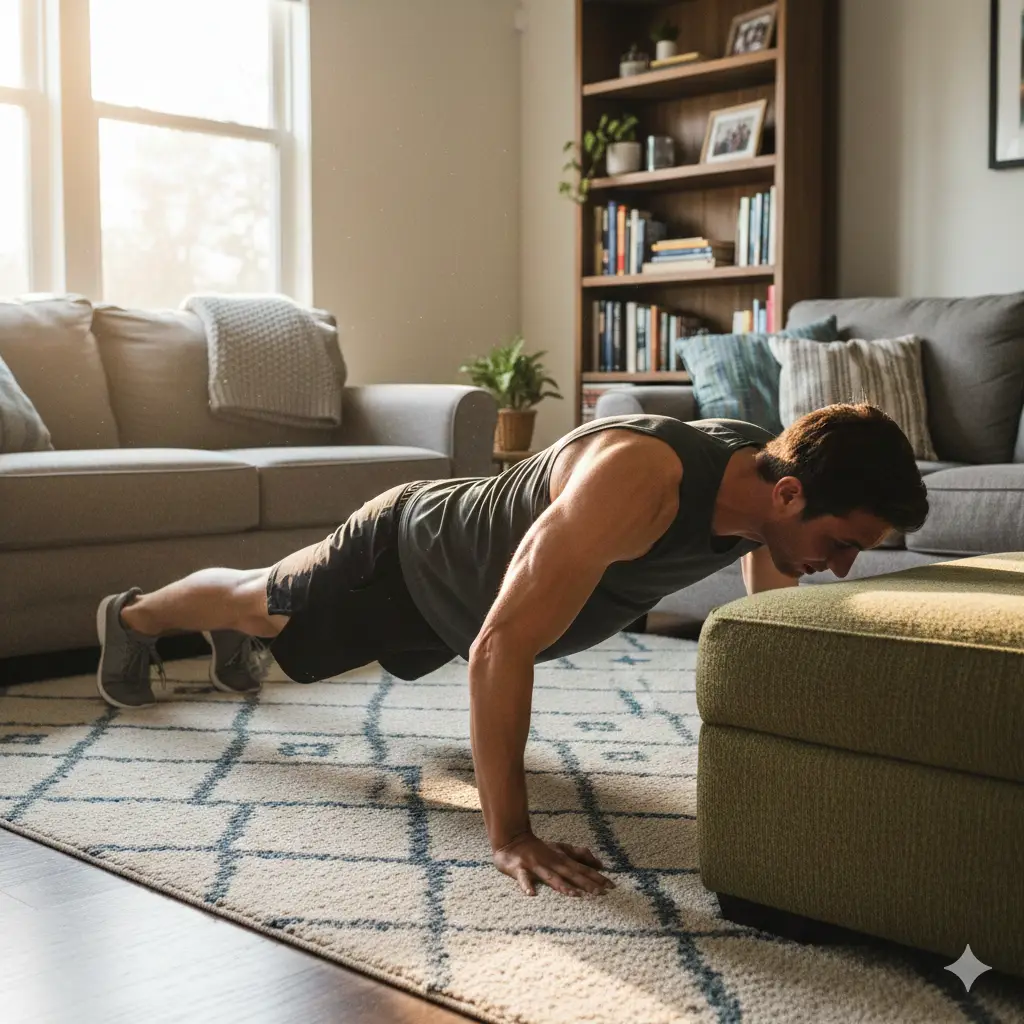
I need you to forget something. Forget the gleaming racks of dumbbells, the intimidating cable machines, and the monthly membership fee. For a moment, I want you to look down at your hands, your arms, your legs. This is your gym. This body you’re in right now is, pound-for-pound, the most sophisticated piece of fitness equipment ever designed.
I used to think like you might. If I missed my session at the crowded gym, I’d write off the day. “Guess I can’t get strong today,” I’d sigh. Then, a few years back, life forced my hand. I spent a month traveling with nothing but a backpack. No hotels with fitness centers. Just me, a hostel room, and a patch of floor. Out of sheer stubbornness, I committed to using only my body-weight. And a funny thing happened: I didn’t just maintain my strength. My pull-ups got cleaner, my core felt like iron, and I discovered a freedom I’d never felt tethered to a machine.
The myth that you need external weight to build real strength is just that—a myth. It’s a story sold by glossy magazines and supplement companies. The truth is simpler, more elegant, and completely free. Strength isn’t about what you lift; it’s about how you move the one weight you can never put down: yourself.
The Physics of You: Why Your Body-weight is the Perfect Load
Let’s get a little nerdy, but I promise to keep it human. Strength training boils down to one principle: progressive overload. You must gradually ask your muscles to do more than they’re used to. Most people think that means adding more iron to the bar. But with body weight training, you manipulate three levers (literally):
-
Leverage: Change the angles. A push-up on your knees isn’t the “easy” version; it’s Physics 101. By shortening the lever (your body), you reduce the load on your pushing muscles. As you master that, you lengthen the lever by going to your toes. Want more? Put your feet on a chair. Suddenly, you’re pushing 70% of your body-weight instead of 50%. No extra plates needed.
-
Tempo: Slow. It. Down. This is the secret weapon nobody uses. Anyone can crank out 10 fast squats. Try this: take four full seconds to lower yourself down, pause for a second at the bottom, then explode up in one second. That “4-1-1” tempo turns a simple squat into a quivering, humbling masterpiece. Time Under Tension (TUT) is what builds muscle, not momentum.
-
Range of Motion: Go deeper. A half-squat is a half-result. Safely increasing your range of motion—getting your thighs parallel to the floor, then below—works your muscles through their full capacity and builds resilient joints. Depth is difficulty you can’t buy.
Your Foundational Five: The Moves That Build Everything
We’re not doing 50 fancy variations. Master these five movement patterns, and you’ve covered 95% of what your body needs. Think of them as your primary colors; you can mix them to create any workout.
1. The Squat (The King of Lower Body)
-
The “Why”: It mimics sitting and standing—the most fundamental human movement. It builds your quads, glutes, hamstrings, and core.
-
The Form Check: Feet shoulder-width, toes slightly out. Push your hips back as if aiming for a chair. Keep your chest up, back straight. Go as low as your mobility allows without rounding your lower back.
-
The Progression Path: Body-weight Squat -> Prisoner Squat (hands behind head) -> Bulgarian Split Squat -> Assisted Pistol Squat.
2. The Push-Up (The Measure of Upper Body Strength)
-
The “Why”: It’s a moving plank that builds chest, shoulders, triceps, and that all-important core stability.
-
The Form Pitfall (The “Dive-Bomber”): Hips sagging toward the floor so your body looks like a hammock. This kills your shoulders and removes the core work.
-
The Fix: Before you move, squeeze your glutes and brace your abs like you’re about to be punched in the gut. Your body should be a rigid, straight board from head to heels.
-
The Progression Path: Wall Push-Up -> Incline Push-Up (on a table) -> Knee Push-Up -> Full Push-Up -> Decline Push-Up.
3. The Hip Hinge (The Deadlift’s Body-weight Cousin)
-
The “Why”: This teaches you to load your powerful posterior chain (glutes, hamstrings) and protects your lower back. Most back pain stems from a weak hinge.
-
The Move: The Single-Leg Romanian Deadlift. Stand on one leg, knee slightly soft. Hinge at your hips, pushing your butt back while keeping your back flat. Lower your torso until you feel a stretch in your standing leg’s hamstring. Return to start. It’s a balance challenge that builds serious strength.
-
The Cue: “Push the wall behind you with your butt.”
4. The Horizontal Pull (The Posture Corrector)
-
The “Why”: Our push-heavy, screen-slouched world makes our back muscles weak. This balances your shoulders and fights that rounded posture.
-
The Move: The Inverted Row (aka Table Row). Find a sturdy table. Lie underneath it, grab the edge with an overhand grip, and walk your feet out until your body is straight. Pull your chest to the table edge. No table? Use a broomstick across two sturdy chairs.
-
The Progression: The more vertical you are (feet closer), the easier. Walk your feet further out to increase difficulty.
5. The Core Anti-Extension (The True “Six-Pack” Builder)
-
The “Why”: Your core’s main job isn’t to crunch; it’s to resist movement—to stop your spine from collapsing. This builds a belt of muscle that protects you in everything you do.
-
The Move: The Dead Bug. Lie on your back, arms extended to ceiling, knees bent at 90 degrees. Slowly and with control, lower your right arm and left leg toward the floor without letting your lower back arch off the ground. Return and switch. It looks easy. A proper 30-second set is brutally humbling.
Building Your “Anytime, Anywhere” Workout
Now, let’s combine these into a potent, 25-minute session you can do in your living room, hotel room, or backyard.
The “No-Excuses” Circuit:
Do each exercise for 40 seconds of work, 20 seconds of rest. Complete 3-4 rounds.
-
Tempo Squats (4 seconds down, 1 second up)
-
Incline or Standard Push-Ups
-
Single-Leg Romanian Deadlifts (20 sec per leg)
-
Table Rows
-
Dead Bugs
The “I Have 10 Minutes” Finisher:
Set a timer for 10 minutes. See how many rounds you can complete of:
-
10 Squats
-
5 Push-Ups
-
10 Alternating Lunges
-
5 Table Rows
-
Hold a Plank for 30 seconds
The Art of Listening (And When to Ignore the Burn)
Body-weight training requires a different kind of awareness. You’re not counting plates; you’re listening to feedback.
-
Good Pain: The deep, muscular burn during the last few reps of a slow set. The shaking of a long plank hold. This is the signal of growth.
-
Bad Pain: Sharp, shooting, or joint-specific pain (knee, shoulder, lower back). This is a stop sign. Regress the exercise (e.g., from full to knee push-ups) or swap it out.
-
The Boredom Test: If a workout feels easy, you’ve outgrown it. Don’t just do more reps mindlessly. Progress: Change the leverage, slow the tempo, or move to the next progression in the path. Your workout log is your best friend here. Note: “Week 1: 3×8 knee push-ups. Week 3: 3×5 full push-ups.”
Your First Assignment: The 7-Day Body-weight Challenge
Don’t overthink it. Start tonight.
-
Day 1: Master the form of the Foundational Five. Do just 1 set of each, focusing purely on technique. Film yourself with your phone—it’s the best coach.
-
Day 2-6: Perform the “No-Excuses” Circuit, aiming for 3 rounds.
-
Day 7: Test yourself with the 10-Minute Finisher. Write down your total rounds.
You’ll be shocked at what happens in just one week. The stiffness fades. The movements feel more natural. You’ll catch yourself standing taller, feeling more capable.
Strength isn’t a location. It’s not a membership card. It’s a skill you build with intention, wherever you are. Your gym is open. It always has been.