
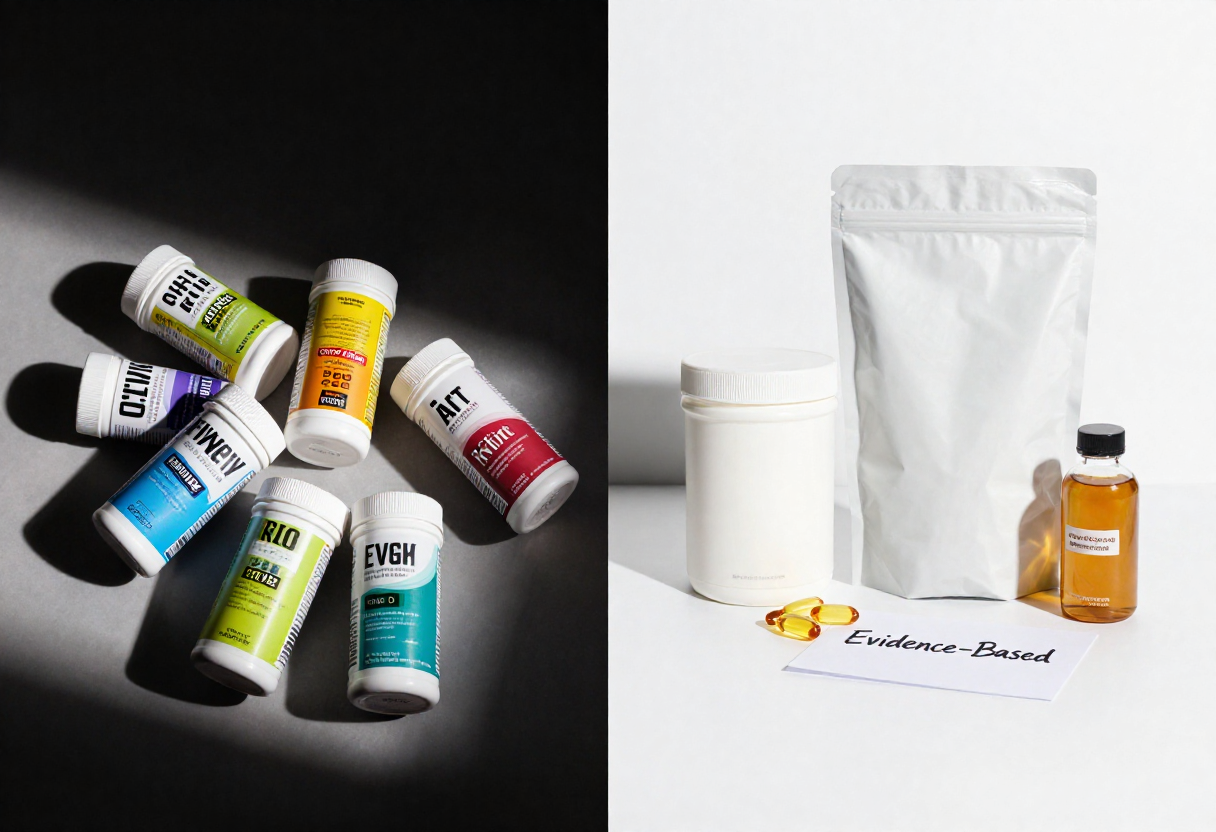
I have a cabinet of shame. Maybe you have one too.
It contains a half-used tub of “nitric oxide booster” that promised vascularity like a bodybuilder but delivered nothing. A bag of “fat burner” that made me jittery, anxious, and not noticeably leaner. A pre-workout so potent it felt like my heart was auditioning for a drum solo. And let’s not discuss the mysterious purple powder a friend sold me that “definitely works, trust me.”
Over the years, I’ve spent hundreds—maybe thousands—on supplements that did absolutely nothing except make my urine more expensive. And I know I’m not alone.
The supplement industry is a $50 billion behemoth built on hope, clever marketing, and scientific-sounding claims that fall apart under scrutiny. Walk into any gym supplement store and you’re confronted by walls of colorful tubs with names like “MASS HYPER-TROPHY MATRIX” and “ANABOLIC IGNITE XTREME.” The guy behind the counter, who gets a commission on what he sells, assures you this is the missing link.
Here’s the uncomfortable truth: Most supplements are a waste of money. A small handful are genuinely useful. Learning the difference will save you hundreds of dollars and endless frustration.
The “Food First” Principle: Supplements Are Called Supplements for a Reason
Before we talk about what to buy, we need to establish the foundation. Supplements supplement a good diet. They don’t replace one.
If your nutrition is a mess—if you’re eating mostly processed food, skipping meals, and barely getting enough protein—no powder on earth will fix you. Supplements work at the margins. They take you from 90% to 95%, not from 30% to 80%.
Think of it like building a house. A good diet is the foundation, the framing, the roof. Supplements are the paint color and the landscaping. Nice to have, but useless if the house is collapsing.
With that established, let’s sort through the noise.
Category 1: The Essentials (Science-Backed and Worth Every Penny)
These supplements have decades of research behind them. They work, they’re safe, and they’re affordable. If you buy nothing else, these are the ones to consider.
Whey Protein (or Plant-Based Equivalent)
Let’s start with the most obvious. Protein powder is simply concentrated protein from food. It’s not magic, it’s not steroids, it’s just food in powder form.
-
What it does: Helps you meet your daily protein requirements for muscle repair and growth. That’s it.
-
Who needs it: Anyone who struggles to get enough protein from whole food. If you’re eating enough chicken, eggs, fish, and dairy, you don’t need powder. If you’re busy and often fall short, powder is a convenient solution.
-
What to buy: Look for minimal ingredients. Whey protein isolate is more processed but has less lactose and fat. Whey concentrate is cheaper and fine for most people. For plant-based, look for blends that combine rice and pea protein for a complete amino acid profile.
-
The honest truth: The $60 tub isn’t better than the $30 tub. Protein is a commodity. Avoid proprietary blends where they don’t tell you exactly how much of each ingredient is inside.
Creatine Monohydrate
This is the most researched supplement in the history of fitness. Over 1,000 studies. Proven safe. Proven effective.
-
What it does: Creatine helps your muscles produce energy during short bursts of intense effort—think lifting heavy, sprinting, anything that lasts under 10 seconds. It also draws water into muscle cells, which can make them look fuller and may aid recovery.
-
Who needs it: Anyone doing resistance training or high-intensity interval work. It’s not just for bodybuilders; it’s for anyone who wants to get a little more out of their workouts.
-
What to buy: Creatine monohydrate. Not creatine hydrochloride, not buffered creatine, not any of the fancy variations. Just the plain white powder. It’s been studied for decades and costs pennies per serving.
-
The honest truth: You don’t need to “load” or “cycle.” Take 3-5 grams daily, forever. Some people experience mild bloating initially as muscles draw in water; it passes.
Vitamin D
This is technically a hormone, not a vitamin. Most of us are deficient, especially if you live far from the equator or spend most of your time indoors.
-
What it does: Supports immune function, bone health, mood regulation, and testosterone production. It’s involved in hundreds of bodily processes.
-
Who needs it: Almost everyone. Get your blood tested if possible, but supplementation is generally safe and recommended.
-
What to buy: Vitamin D3 (cholecalciferol) is the form your body makes from sun. Look for drops or softgels. Many combine with K2, which helps direct calcium to bones instead of arteries.
-
The honest truth: You can’t get enough from food alone. Sun is best, but if you’re indoors, supplement.
Omega-3 Fatty Acids (Fish Oil)
Modern diets are wildly skewed toward omega-6 fats (from vegetable oils, processed foods) and away from anti-inflammatory omega-3s.
-
What it does: Reduces inflammation, supports brain health, improves joint recovery, and may aid heart health.
-
Who needs it: Anyone who doesn’t eat fatty fish (salmon, mackerel, sardines) at least twice a week.
-
What to buy: Look for a brand that provides EPA and DHA amounts on the label (not just “fish oil”). Aim for at least 500-1000mg combined EPA/DHA daily. Third-party tested for heavy metals.
-
The honest truth: Fish burps are real. Keeping the bottle in the freezer can help, or look for enteric-coated versions.
Category 2: The “Maybe Helpful” (Conditional and Individual)
These supplements work for some people in some situations. They’re not essential, but they have their place.
Caffeine (Pre-Workout)
Caffeine is the most widely used performance enhancer in the world. It works.
-
What it does: Blocks adenosine (the “I’m tired” chemical), increases alertness, and can improve focus and performance during workouts.
-
Who needs it: People who train early, train after poor sleep, or want an extra boost. If you train in the evening, caffeine might disrupt sleep.
-
What to buy: You don’t need a fancy pre-workout with 47 ingredients. A cup of coffee works. If you want a powder, buy pure caffeine or a simple pre-workout with known doses (not proprietary blends).
-
The honest truth: Tolerance builds fast. Cycle off periodically to keep it effective. And please, read labels—some pre-workouts have dangerous levels of caffeine.
Beta-Alanine
That tingling, itchy feeling you get from some pre-workouts? That’s beta-alanine.
-
What it does: Buffers acid in muscles during high-intensity exercise, potentially allowing you to do one or two more reps.
-
Who needs it: People doing high-rep training (10-15+ reps) or repeated sprints. Less useful for pure strength work.
-
What to buy: Pure beta-alanine powder is cheap. The tingling (paresthesia) is harmless but can be startling.
-
The honest truth: The effect is small but real. You need to take it consistently for weeks to build up levels in muscles.
Magnesium
Essential mineral involved in hundreds of reactions, including muscle relaxation and sleep.
-
What it does: Supports recovery, sleep quality, and muscle function. Many people are deficient due to depleted soils and processed diets.
-
Who needs it: Anyone with muscle cramps, poor sleep, or high stress levels. Also athletes who sweat heavily.
-
What to buy: Magnesium glycinate or citrate are well-absorbed. Oxide is cheap but poorly absorbed (it’s basically a laxative).
-
The honest truth: Food sources (pumpkin seeds, spinach, almonds) are best, but supplementation helps many people.
Category 3: The Garbage (Save Your Money)
This is where the supplement industry makes its real money. These products are backed by clever marketing, not science. Avoid them.
BCAAs (Branched-Chain Amino Acids)
If you eat enough protein, you’re already getting plenty of BCAAs. They’re three of the nine essential amino acids, and they’re present in any complete protein source.
-
Why they’re garbage: If you’re eating meat, eggs, or dairy, you don’t need them. If you’re plant-based, you need all essential amino acids, not just these three. The research shows no benefit over simply eating enough total protein.
-
What the marketing says: “Prevent muscle breakdown!” “Sip during workouts!” It’s mostly nonsense.
-
The honest truth: BCAA supplements are expensive, flavored water with a tiny amount of amino acids. Just eat protein.
Fat Burners
Every few years, a new fat burner hits the market. Every few years, it’s the same story: stimulants, a few herbs with questionable research, and a hefty price tag.
-
Why they’re garbage: Most “fat burning” ingredients have minimal to no effect in humans at reasonable doses. The ones that do work (strong stimulants) come with side effects and tolerance issues.
-
What the marketing says: “Ignite your metabolism!” “Target stubborn fat!” It’s all vague, unproven claims.
-
The honest truth: If fat burners worked, obesity wouldn’t exist. The only proven way to lose fat is a calorie deficit. Save your money.
Testosterone Boosters
This is one of the cruelest categories. They target men worried about low testosterone and promise natural increases.
-
Why they’re garbage: Ingredients like tribulus terrestris, fenugreek, and D-aspartic acid have been studied repeatedly. The results? Essentially zero effect on testosterone in healthy men.
-
What the marketing says: “Scientifically proven to increase free testosterone!” The “studies” are often tiny, poorly designed, or funded by the supplement company.
-
The honest truth: If you have clinically low testosterone, see a doctor. If you don’t, these won’t help. They’re expensive placebos.
Detox Teas and Cleanses
Your body has a detox system. It’s called your liver and kidneys. They work 24/7 without any help from overpriced tea.
-
Why they’re garbage: The weight loss from “cleanses” is water weight and lost stool content. It returns immediately when you eat normally. The “detox” claims have no scientific basis.
-
What the marketing says: “Flush toxins!” “Reset your system!” Your system doesn’t need resetting.
-
The honest truth: Many of these products contain laxatives that can cause dehydration and electrolyte imbalances. Just drink water and eat vegetables.
Most “Anabolic” Formulas
Anything with “anabolic,” “growth,” or “matrix” in the name is probably overpriced marketing.
-
Why they’re garbage: Real anabolic compounds are steroids and require prescriptions. The ingredients in these formulas (zinc, magnesium, various herbs) won’t come close to replicating those effects.
-
The honest truth: If it sounds too good to be true, it is.
How to Read a Supplement Label (Without Getting Fooled)
Before you buy anything, flip the bottle over and look for three things:
1. Third-Party Testing Seals
Look for NSF Certified for Sport, Informed Choice, or USP verification. These mean an independent organization has tested the product and confirmed it contains what the label says, without banned substances or contaminants.
Many cheap supplements skip this testing. The label might be lying about what’s inside.
2. Proprietary Blends (Avoid)
If you see “Proprietary Blend” followed by a list of ingredients and a total weight, run. This means the company doesn’t have to tell you how much of each ingredient is actually in the product. That “1,500mg blend” could be 1,400mg of cheap rice flour and 100mg of the active ingredient.
3. Specific Doses
Good supplements list exact amounts of each active ingredient. “Magnesium 400mg (as magnesium glycinate)” is transparent. “Magnesium (proprietary blend)” is not.
The Only Supplements Most People Actually Need
If you’re on a budget and want to spend your money wisely, here’s the short list:
-
Protein powder: If you struggle to hit your protein targets.
-
Creatine monohydrate: 3-5 grams daily, forever.
-
Vitamin D3: Especially if you live in a northern climate.
-
Fish oil: If you don’t eat fatty fish regularly.
That’s it. Everything else is optional, conditional, or a waste.
The Supplement Aisle Mindset
Walking through a supplement store can make you feel like you’re missing out. The flashy labels, the ripped athletes, the claims of “revolutionary” ingredients—it’s designed to create insecurity and sell solutions.
Here’s what I’ve learned after years of wasting money: The best “supplement” is consistency. Showing up, training hard, eating well, sleeping enough. No powder replaces those fundamentals.
Supplements are the smallest piece of the puzzle. Get the big pieces right first. Then, if you have money left over and want to optimize at the margins, consider the essentials.
Your wallet—and your body—will thank you.
The supplement industry profits from your confusion. Arm yourself with knowledge, buy only what works, and spend the rest of your money on good food. That’s a formula that never fails.