
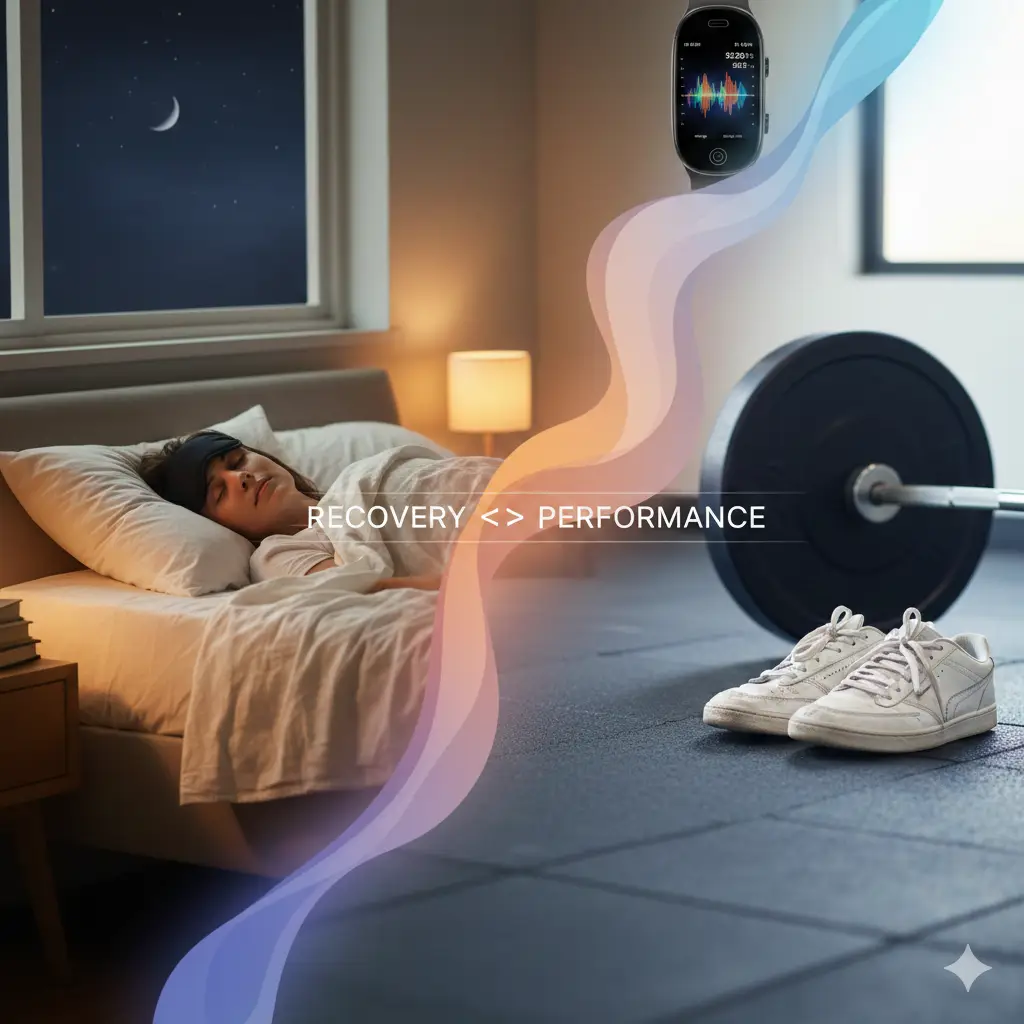
You can crush every workout with perfect form. You can meal prep like a Michelin-starred chef and hydrate like you’re crossing the Sahara. But if you’re skimping on sleep, you’re leaving somewhere between 30 and 40 percent of your results on the table. Maybe more.
We’ve been sold a dangerous lie: that sleep is downtime. That it’s optional. That “I’ll sleep when I’m dead” is a badge of honor worn by the productive and driven. Let me flip that narrative for you right now: Sleep isn’t the absence of progress. It is the engine of it.
Think about it this way. You wouldn’t renovate a house while the construction crew is still swinging hammers. You’d wait until they leave, when it’s quiet, so the painters can work, the electricians can wire, and the finishing touches can be applied. During sleep, your body kicks out the construction crew of your waking life—the movement, the digestion, the thinking—and sends in the overnight restoration team.
If you’re not sleeping, that team never shows up. And your body stays a half-renovated house, day after day.
The Invoice You Can’t Ignore: What Sleep Deprivation Actually Costs You
Let’s look at the receipt. Research published in the Journal of Clinical Endocrinology & Metabolism found that just one week of sleeping five hours per night dropped testosterone levels in healthy young men by 10 to 15 percent. That’s the equivalent of aging ten to fifteen years in seven days. Testosterone isn’t just about muscle; it’s about recovery, energy, mood, and metabolic health.
For women, the story is similar, though the hormones differ. Sleep deprivation disrupts the delicate dance of estrogen and progesterone, affecting everything from menstrual regularity to stress resilience to body composition.
But hormones are just the beginning.
Muscle Recovery: During deep sleep, your pituitary gland releases pulses of growth hormone (GH) . This is the foreman of your overnight construction crew. GH stimulates tissue repair, muscle growth, and bone density. It tells your body, “Take those amino acids from the protein you ate, and rebuild the muscle fibers you broke down today.” Without adequate deep sleep, that signal is muted. Your workout was just demolition without reconstruction.
Fat Storage: When you’re sleep-deprived, your body goes into a mild state of stress and metabolic chaos. Cortisol, your stress hormone, remains elevated. Elevated cortisol signals your body to hold onto fat—particularly visceral fat, the dangerous kind that wraps around your organs. At the same time, sleep loss dysregulates two critical hunger hormones:
-
Leptin (the “I’m full” hormone) plummets, so you never feel satisfied.
-
Ghrelin (the “I’m hungry” hormone) surges, so you’re constantly craving calories, especially carbohydrates and sugar.
You’re not weak-willed when you’re tired. You’re biologically hijacked. Your body is screaming for quick energy because it thinks it’s in a survival scenario.
The Sleep Debt Credit Card: With High Interest
I want you to imagine a credit card with a terrible, predatory interest rate. Every hour of sleep you miss is a charge you put on that card. A few late nights here and there? Manageable. But the “debt” accumulates silently, with compounding interest.
The payment comes due in the form of:
-
Injury: Reaction time slows, coordination suffers. You’re more likely to drop a weight or twist an ankle.
-
Illness: Your immune system is decimated. Studies show people sleeping less than seven hours are nearly three times more likely to catch a cold than those sleeping eight hours.
-
Plateaued Progress: You’re in the gym, but your strength isn’t increasing, your times aren’t dropping, and your body composition isn’t changing. You’re spinning your wheels.
-
Insatiable Cravings: That 3 PM pull toward the vending machine isn’t moral failure; it’s a dysregulated ghrelin signal demanding repayment of the sleep debt.
You can’t repay sleep debt with “extra” sleep on the weekend, just like you can’t fix a week of poor eating with one salad. But you can stop adding to the balance and slowly, consistently, pay it down.
The Athlete’s Open Secret: Why the Pros Prioritize Sleep
LeBron James reportedly sleeps twelve hours a night. Roger Federer averages eleven. Usain Bolt credited eight to ten hours of sleep as essential to his training. When asked what he’d do differently in his career, Arnold Schwarzenegger once said he wished he’d slept more.
These aren’t lazy people. These are the most physically accomplished humans on the planet. They understand something that the “hustle culture” crowd misses: Sleep is not the opposite of performance. It is the prerequisite for it.
In a Stanford study, basketball players who were instructed to sleep ten hours per night saw their sprint times improve and their free-throw accuracy increase by 9 percent. They didn’t change their training. They changed their sleep.
If you want to perform like an elite athlete, you must recover like one. The gym is where you break down. The bed is where you build up.
Your Sleep Hygiene Prescription: A Coach’s Orders
This isn’t a list of gentle suggestions. If you’re serious about your fitness, these are non-negotiable environmental levers for hormone optimization and recovery.
Prescription 1: The Digital Sunset (60 Minutes)
One hour before bed, all screens go dark. Not dimmed. Off. The blue light emitted by phones, tablets, and computers suppresses melatonin—your body’s “time to sleep” signal—by tricking your brain into thinking it’s still daytime.
-
Instead: Read a physical book. Listen to a podcast (not a thriller). Have a conversation. Stare out the window like a Victorian child. Anything but the screen.
Prescription 2: Temperature Control (The 65-Degree Rule)
Your body needs to drop its core temperature by one to two degrees to initiate and maintain sleep. A cool room helps this happen.
-
The Target: Set your thermostat between 65 and 68 degrees Fahrenheit (18-20°C). If you can’t control the temperature, optimize your bedding and sleep with less covers than you think you need.
Prescription 3: Total Darkness (The Cave Protocol)
Even small amounts of light—an LED on a power strip, light bleeding through curtains—can disrupt melatonin production and fragment sleep architecture.
-
The Fix: Invest in blackout curtains. If you can’t, use a quality sleep mask. Cover or remove any electronic lights in your bedroom. Your sleep space should be as dark as a cave.
Prescription 4: Consistency (The Anchor)
Going to bed and waking at the same time—yes, even on weekends—is one of the most powerful levers you can pull. Your body craves rhythm. A consistent schedule trains your circadian rhythm to predict sleep and wakefulness, making both easier.
-
The Rule: Pick a wake time and stick to it, no matter what. Even if you slept poorly. Even on Sunday. This anchors your entire cycle.
Prescription 5: The Pre-Bed Ritual (The Wind-Down)
You wouldn’t sprint into your living room and collapse onto the couch expecting instant relaxation. You need a ramp. Create a 30- to 60-minute ritual that signals to your nervous system, “We are transitioning now.”
-
Ideas: Light stretching, gentle foam rolling, journaling three things you’re grateful for, a warm (not hot) shower, herbal tea, deep breathing.
The 3 AM Mind Race: What to Do When Your Brain Won’t Shut Up
You’re in bed. You’re tired. But your brain has decided this is the perfect moment to replay every awkward conversation from the last decade and stress about a meeting that’s three weeks away.
Don’t lie there fighting it. That turns your bed into a battleground.
-
Get up. Go to another room. Keep the lights low.
-
Do something boring. Read a physical book. Fold laundry. Listen to a calm, familiar podcast. No screens.
-
Return only when you feel sleepy. Your bed must remain associated with sleep, not with frustrated wakefulness.
This technique, used in cognitive behavioral therapy for insomnia, breaks the cycle of bed = frustration.
Your First Step: Tonight’s Small Win
Don’t try to fix everything at once. Start with one thing tonight:
-
Charge your phone in another room. Just this one change eliminates late-night scrolling and early-morning checking. It creates a physical boundary between you and the screen.
-
Notice how you feel tomorrow.
Sleep isn’t a luxury you earn after you’ve done everything else. It is the foundation upon which everything else is built. Treat it that way, and watch what your body becomes capable of.
The difference between the results you’re getting and the results you want might not be another set in the gym. It might be another hour in bed. Tonight, give yourself permission to find out