
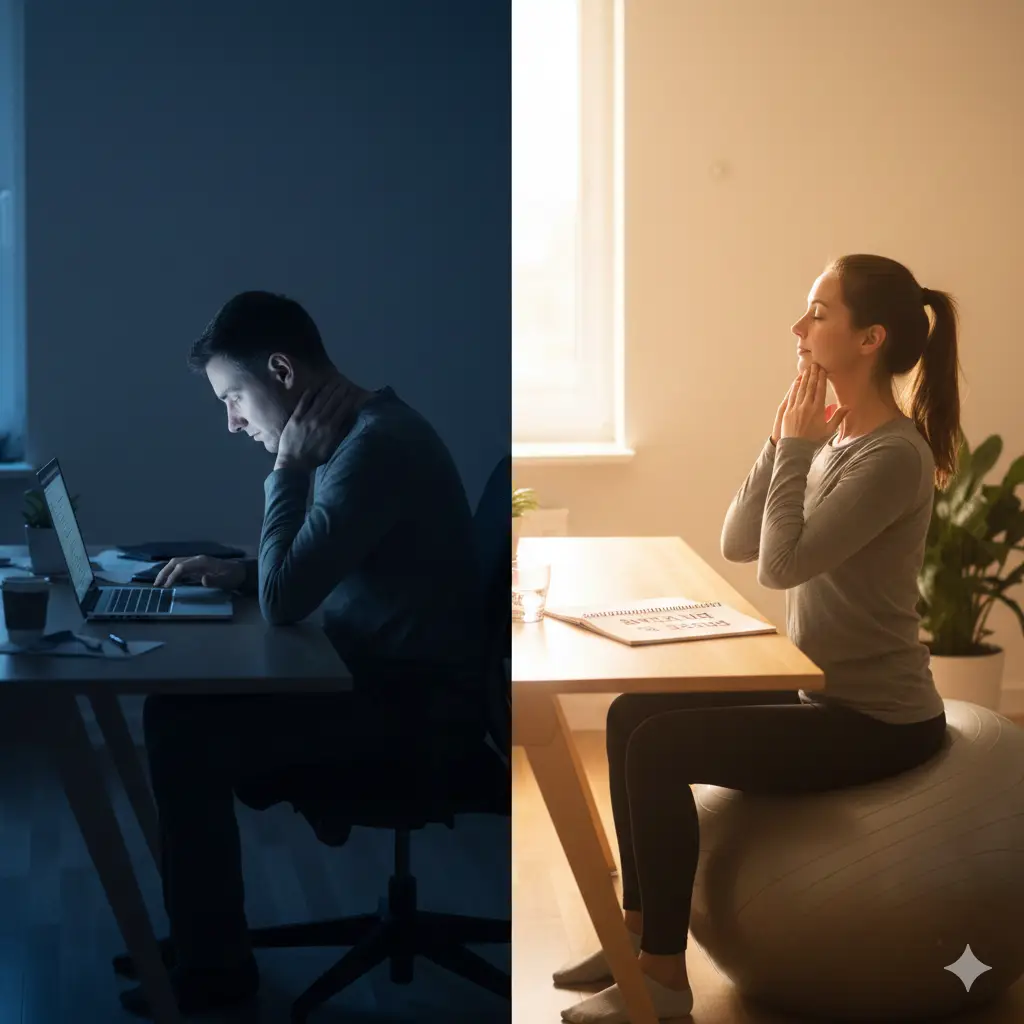
Let me ask you a question that will probably hit a nerve—literally. Right now, as you read this on your phone or computer, where are your shoulders? Are they rounded forward, creeping up toward your ears? Is your head jutting out, chin forward, as if trying to get closer to the screen? If you’re like 90% of the modern world, the answer is yes. And that familiar, dull ache between your shoulder blades at 3 PM? That’s not just stress. It’s a direct invoice from your posture.
For years, I thought posture was about aesthetics. “Stand up straight!” my mom would say. I’d throw my shoulders back for a photo, then slump right back into my comfy, collapsed C-shape. It wasn’t until I started working with a brilliant physical therapist after a lifting injury that I learned the truth: Poor posture isn’t just how you look. It’s a silent thief, stealing your strength, restricting your breathing, and setting the stage for chronic pain.
This isn’t about standing like a soldier. This is about reclaiming the functional architecture of your body so you can move pain-free, breathe deeper, and yes—finally see the strength gains in the gym that have been eluding you.
The Self-Assessment: The 60-Second Wall Test You Can’t Fail (Only Learn From)
Before we fix anything, we need to see the problem. Do this right now.
Stand with your back against a wall. Your heels, butt, and shoulder blades should be touching it. Now, try to press the back of your head flat against the wall without craning your neck upward.
Could you do it? Without straining or tilting your chin to the ceiling?
If you had to crane, you’ve got what we call Forward Head Posture (Tech Neck). If your shoulders fought to touch the wall or your chest felt tight, you’ve got Rounded Shoulders (Upper Crossed Syndrome).
This simple test reveals the imbalance we’re about to tackle. The muscles in the front of your body—your pecs and anterior deltoids—have become short and tight from constant hunching. The muscles in the back—your rhomboids, lower traps, and deep neck flexors—have become long and weak from being constantly stretched. It’s like having overzealous bouncers in the front, pulling you forward, while the security guards in the back are asleep on the job.
Meet the Muscles: The Cast of Characters in Your Posture Drama
Let’s put names to the feelings so you can understand what we’re actually trying to change.
-
The Overzealous Bouncers (Tight & Short):
-
Pectoralis Major/Minor: Your chest muscles. They’re designed to pull your arms across your body. From driving, typing, and scrolling, they’re in a constant state of slight contraction, pulling your shoulders inward.
-
Upper Trapezius & Levator Scapulae: The “Oh my god, I’m so stressed” muscles. They hunch your shoulders up to your ears. That knot at the base of your skull? That’s them.
-
-
The Sleeping Security Guards (Weak & Lazy):
-
Rhomboids & Mid/Lower Trapezius: These are your “posture muscles.” They pull your shoulder blades back and down, creating that proud, open chest. In a slouch, they’re switched off.
-
Deep Neck Flexors: These are the small muscles in the front of your neck that should hold your head up. When they’re weak, your big, strap-like sternocleidomastoid muscles on the side take over, yanking your head forward.
-
The 3-Part Prescription: Calm, Wake, Integrate
We don’t just “strengthen the back.” That’s like trying to arm-wrestle while someone has you in a headlock. First, we calm down the overactive muscles (release the tension), then we wake up the underactive ones (re-teach them to fire), and finally, we integrate it all into how you move.
Part 1: Calm the Bouncers (Release)
1. The Doorway Pec Stretch (Your New Best Friend)
-
How-To: Stand in a doorway. Place your forearms on the frame with elbows bent at 90 degrees, forming a “goalpost.” Step one foot forward until you feel a deep stretch across your chest and the front of your shoulders. Do not arch your lower back.
-
The Pro-Tip: Breathe deeply into your rib cage, expanding it sideways against the stretch. Hold for 30-45 seconds, 2-3 times a day. Set a timer at your desk for every 25 minutes. This 60-second break is more powerful than any ergonomic chair.
2. The Levator Scapulae Release (Goodbye, Neck Knot)
-
How-To: Sit tall. Reach your right hand over your head and place it on the left side of your head. Gently pull your head toward your right shoulder until you feel a stretch on the left side of your neck. For a deeper release, look down slightly toward your right armpit.
-
Hold for 30 seconds per side. This directly targets that stubborn knot.
Part 2: Wake the Guards (Activate & Strengthen)
1. The Chin Tuck (The #1 Exercise for Tech Neck)
-
How-To: Sit or stand tall. Place two fingers on your chin. Without moving your fingers, gently draw your chin straight back, as if you’re making a double chin. You should feel the muscles in the front of your neck engage and a stretch in the back. Hold for 3-5 seconds, release. Do 10-15 reps, 3x a day.
-
The Mind-Blowing Cue: “Make your neck longer.” This simple cue activates your deep neck flexors like nothing else.
2. Prone Ys and Ts (Wake Up Your Sleeping Back)
-
How-To: Lie face down on the floor, forehead on a towel. For the “Y”: Extend your arms overhead at a 45-degree angle, thumbs up. Squeeze your shoulder blades down and together as you lift your arms a few inches off the ground. Think of pulling your hands toward your hips. For the “T”: Extend arms straight out to sides, palms down, and lift.
-
Do 2 sets of 10-12 reps of each, 3x a week. This is non-negotiable homework. It directly targets your rhomboids and lower traps.
Part 3: Integrate Into Movement (Breathe & Move)
The Game-Changer: Ribcage Breathing
The best posture cue isn’t “shoulders back.” It’s a full breath. When you slouch, you can only breathe into the top of your lungs. When you sit or stand tall, you can breathe 360 degrees.
-
Practice: Sit tall. Place your hands on the sides of your ribcage. Inhale deeply through your nose, trying to expand your ribs into your hands sideways. Exhale fully. Do this for 5 breaths, multiple times a day. This breath alone will naturally improve your posture more than any forced position.
The Truth About Posture Corrector & Quick Fixes
Let’s be blunt: those posture-correcting braces you see online? They’re a crutch. An expensive one. They provide an external support system, which means the very muscles we’re trying to wake up get to take an even longer nap. You might feel better while wearing it, but you’re not building the internal, muscular brace that lasts a lifetime. Save your money. Invest your time in the exercises above instead.
Your 8-Minute Daily Desk Reset Routine
This is your actionable plan. Do this sequence once in the morning and once in the mid-afternoon slump.
-
Doorway Pec Stretch: 30 seconds per side. (Calm)
-
Chin Tucks: 15 slow, controlled reps. (Wake)
-
Seated Cat-Cow: 5 rounds—arch your back, look up, then round your spine, tuck chin. (Mobilize)
-
Ribcage Breathing: 5 deep breaths, hands on ribs. (Integrate)
-
Prone Ys/Ts (at home): 1 set of each if you can get on the floor. (Strengthen)
The Real-World Payoff: Beyond Just Standing Straight
When you commit to this for just two weeks, the changes are profound:
-
In the Gym: Your bench press and overhead press form improves because your scapulae can move properly. Your deadlifts feel safer because your upper back is engaged.
-
In Life: Headaches diminish. Breathing feels fuller. That 3 PM ache disappears. You appear more confident without trying.
-
The Mind-Body Link: An upright posture is clinically linked to reduced stress hormones and increased feelings of power and optimism.
- Your posture isn’t a pose. It’s the foundation of every movement you make. Rebuild it, and you rebuild your potential for strength, health, and vitality. Start with your next breath.