
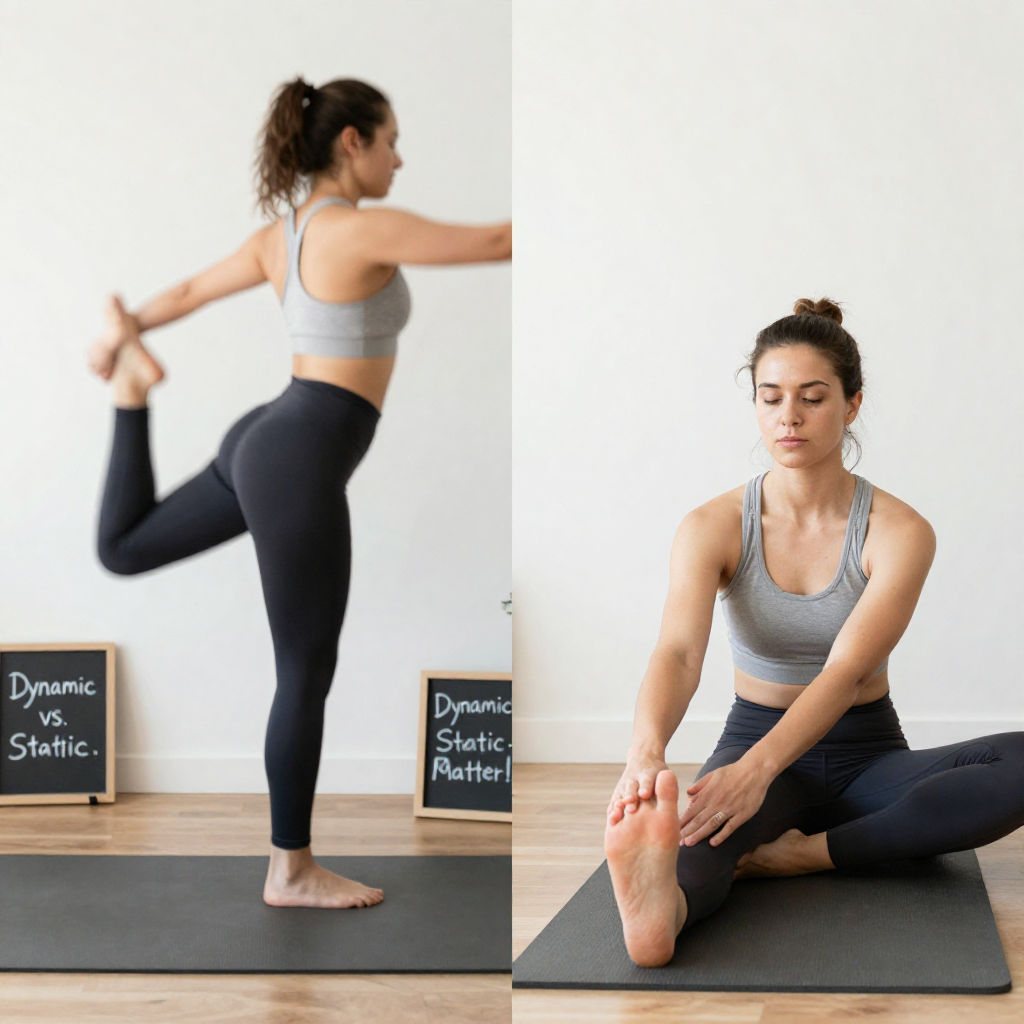
Let me ask you something. Before a workout, do you reach down and try to touch your toes, holding for 30 seconds? Maybe you’ve been doing that for years, believing you’re “warming up” and preventing injury.
Here’s the truth that might surprise you: That static stretch you’re holding? It’s not warming you up. It might actually be making things worse.
I used to think stretching was stretching. Touch your toes, hold, done. It wasn’t until I started working with a coach who kept saying “mobility, not just flexibility” that I realized I’d been misunderstanding movement for decades.
Stretching and mobility are not the same thing. They serve different purposes, and confusing them can leave you tighter, more injury-prone, and wondering why you’re not making progress.
Let’s fix that today.
First, Let’s Define Our Terms
What Is Flexibility?
Flexibility is the ability of a muscle to lengthen passively. It’s about range of motion without active control.
When you sit on the floor and reach for your toes, holding the position, you’re measuring hamstring flexibility. You’re not using muscles to get there—you’re relaxing into a stretch.
Flexibility is passive.
What Is Mobility?
Mobility is the ability to move a joint actively through its full range of motion with control. It’s flexibility plus strength.
When you do a deep squat and can control the movement up and down without falling over, that’s mobility. When you lift your leg to the side while standing, that’s mobility.
Mobility is active.
Dr. Kelly Starrett, a renowned physical therapist and mobility expert, puts it simply: “Mobility is the ability to produce a movement requirement at a joint with control and without restriction.”
Why the Difference Matters
You can have excellent flexibility and terrible mobility. Many gymnasts and dancers are incredibly flexible but lack stability in those ranges. Conversely, you can have good mobility without being exceptionally flexible.
Here’s what matters for everyday life and fitness:
-
Flexibility without strength = instability and injury risk
-
Strength without flexibility = restricted movement and compensation patterns
-
Mobility (flexibility + strength) = resilient, capable movement
The Science: What Actually Happens When You Stretch
When you stretch a muscle, several things occur:
Acutely: The muscle spindle (a sensory receptor) senses the stretch and signals the muscle to contract slightly—a protective mechanism. After about 30 seconds of holding, the Golgi tendon organ (another receptor) overrides this and tells the muscle to relax. This is why you feel a release after holding a stretch.
Chronically: Regular stretching can increase your tolerance to the stretch sensation and may actually lengthen muscles and fascia over time. But the changes are gradual—you’re not physically “lengthening” muscle fibers in a few sessions.
For warm-ups: Static stretching before activity actually decreases power output temporarily. Studies show it can reduce strength, sprint speed, and jumping performance for up to an hour after stretching.
This is why static stretching before a workout is counterproductive. You’re telling your muscles to relax right before asking them to perform.
The Right Way: Dynamic vs. Static
Dynamic Stretching (For Warm-Ups)
Dynamic stretching involves moving parts of your body through a full range of motion while gradually increasing reach and speed. It’s active, it’s movement-based, and it prepares your body for activity.
What it does:
-
Increases blood flow to muscles
-
Raises core temperature
-
Activates the nervous system
-
Improves dynamic flexibility
-
Enhances performance
Examples:
-
Leg swings (forward and side)
-
Arm circles
-
Walking lunges
-
Torso twists
-
Hip circles
-
Cat-cow stretches
-
Inchworms
Static Stretching (For Cool-Downs)
Static stretching involves holding a position at the end range of motion for 20-60 seconds. This is what most people think of as “stretching.”
What it does:
-
Promotes relaxation
-
May reduce post-exercise soreness
-
Improves passive flexibility over time
-
Helps with recovery
Examples:
-
Seated hamstring stretch
-
Quad stretch holding foot
-
Chest stretch in doorway
-
Butterfly stretch
-
Child’s pose
The Golden Rule
Dynamic before activity. Static after activity (or on separate days).
Warm up with movement. Cool down with stillness.
Your 10-Minute Daily Mobility Routine
This routine combines dynamic movement for warm-up and static holds for areas that tend to tighten. Do it in the morning, before workouts, or whenever you need to unlock stiff joints.
Part 1: Dynamic Mobility (5 minutes)
1. Neck Rolls (30 seconds)
Slowly roll your head in circles, one direction then the other. Keep shoulders relaxed.
2. Arm Circles (30 seconds)
Small circles forward, then backward. Gradually increase size.
3. Torso Twists (30 seconds)
Feet shoulder-width, arms out, twist side to side from the waist. Keep hips facing forward.
4. Hip Circles (30 seconds)
Hands on hips, circle hips clockwise, then counterclockwise.
5. Leg Swings (1 minute)
Hold onto something for balance. Swing one leg forward and back (30 seconds), then side to side (30 seconds). Repeat on other leg.
6. Walking Lunges (1 minute)
Step forward into a lunge, keeping front knee behind toes. Alternate legs.
7. Cat-Cow (30 seconds)
On hands and knees, alternate between arching your back (cow) and rounding it (cat).
8. World’s Greatest Stretch (1 minute)
From lunge position, drop back knee. Place opposite hand on floor, twist toward front leg, reaching arm toward ceiling. Hold briefly, then switch sides.
Part 2: Targeted Static Stretches (5 minutes)
Hold each for 30-45 seconds, breathing deeply.
1. Hamstring Stretch
Sit on floor, one leg extended, other bent. Hinge at hips, reaching toward extended foot.
2. Quad Stretch
Standing, pull one heel toward glute. Keep knees together.
3. Chest Stretch
In doorway, place forearms on frame, lean forward gently.
4. Butterfly Stretch
Sit, soles of feet together, knees drop toward floor. Hold ankles, gently press knees down.
5. Child’s Pose
Kneel, sit back on heels, fold forward, arms extended.
Common Mobility Problem Areas (And How to Fix Them)
Tight Hips
Why it happens: Sitting for hours shortens hip flexors and weakens glutes.
Fix it:
-
Hip flexor lunges (dynamic)
-
Pigeon pose (static)
-
Glute bridges (strengthening)
-
90/90 stretches (mobility)
Rounded Shoulders
Why it happens: Desk work, phone use, forward head posture.
Fix it:
-
Doorway chest stretches (static)
-
Face pulls (strengthening)
-
Thoracic extensions over foam roller
-
Wall slides
Stiff Upper Back
Why it happens: Poor posture, lack of rotational movement.
Fix it:
-
Thoracic rotations on hands and knees
-
Foam roller extensions
-
Thread the needle stretch
-
Cat-cow variations
Tight Hamstrings
Why it happens: Sitting, lack of movement, overtraining without stretching.
Fix it:
-
Dynamic leg swings
-
Deadlifts with proper form (strengthening through range)
-
Seated forward fold (static after workouts)
Mobility Myths Debunked
Myth 1: “Stretching prevents injury”
Research is mixed. Static stretching before activity doesn’t significantly reduce injury risk—and may increase it by temporarily weakening muscles. What actually prevents injury? Strong, controlled movement through full ranges (mobility), proper warm-up (dynamic movement), and not doing too much too soon.
Myth 2: “You should feel pain when stretching”
No. A stretching sensation (mild discomfort) is fine. Sharp pain is not. Pain indicates tissue stress or injury. Back off.
Myth 3: “More flexible is always better”
Hypermobility (excessive flexibility) without control increases injury risk. Joints need stability too. The goal is adequate flexibility with good control.
Myth 4: “You can target specific muscles to lengthen”
You can improve range at a joint, but muscles don’t work in isolation. Stretching affects the entire kinetic chain.
Myth 5: “Hold stretches for at least 60 seconds”
For general fitness, 20-30 seconds is sufficient. Longer holds are for specific therapeutic goals, not general wellness.
Mobility Tools: Helpful or Hype?
Foam rollers: Excellent for releasing muscle tension and improving tissue quality. Use before dynamic warm-ups.
Massage balls: Great for targeted work on knots and trigger points.
Resistance bands: Useful for mobility drills and controlled stretching.
Theraguns and percussion devices: Can help with muscle recovery but don’t replace mobility work.
Stretching straps: Helpful for beginners who can’t reach their feet comfortably.
Verdict: Tools can help, but you don’t need them. Bodyweight mobility work is free and effective.
Sample Weekly Mobility Schedule
| Day | Focus |
|---|---|
| Monday | Full body dynamic (5-10 min AM) |
| Tuesday | Hip-focused mobility + static hamstrings |
| Wednesday | Full body dynamic (pre-workout) |
| Thursday | Upper body (shoulders, thoracic) |
| Friday | Full body dynamic + lower body static |
| Saturday | Active recovery (yoga or mobility flow) |
| Sunday | Rest or gentle stretching |
The Bottom Line
Stretching and mobility are not the same. Flexibility is passive; mobility is active. Both matter, but they serve different purposes.
-
Use dynamic movement to warm up
-
Use static stretching to cool down or on rest days
-
Build mobility (strength through range) for resilient, capable movement
Your body is designed to move. When you take it through full ranges with control, you’re not just preventing injury—you’re unlocking the ability to do everything better. Lift heavier, run farther, play with your kids, get off the floor easily, reach that top shelf without strain.
Movement is freedom. And freedom starts with mobility.