
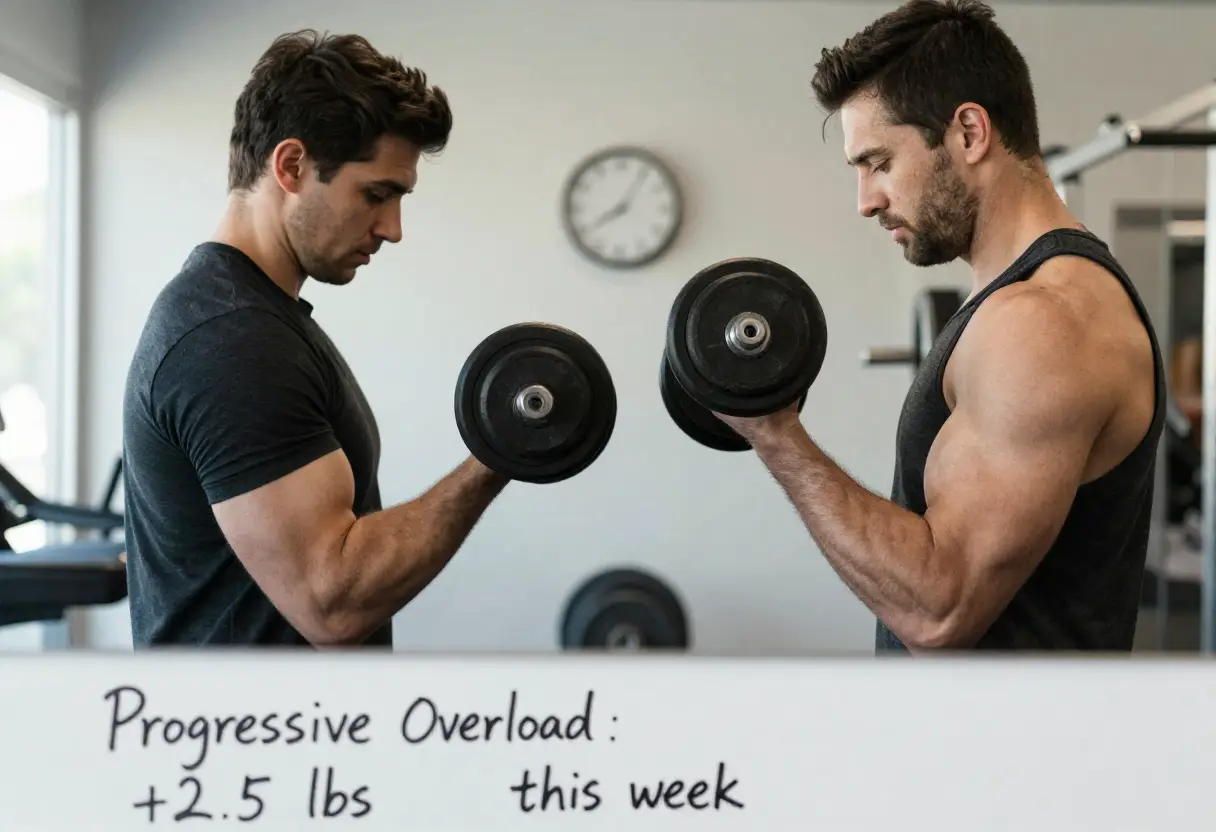
I need to confess something embarrassing. For the first year I took fitness seriously, I did the exact same workout. Every single week. Same exercises, same weight, same number of reps, same everything. I’d walk into the gym, go through the motions I’d memorized, and walk out feeling like I’d accomplished something.
And for months, I couldn’t figure out why I looked exactly the same.
I was consistent. I showed up. I sweated. But my body had no reason to change. It had already adapted to the stress I was giving it, and I wasn’t asking for anything more. I was like someone who expected to learn Spanish by reading the same page of a textbook every day.
Here’s the truth they don’t put on inspirational gym posters: Muscles don’t grow from comfort. They grow from being forced to adapt to demands they haven’t met before. If you’re doing the same thing today that you did three months ago, you’re not building strength. You’re just burning time.
This is where progressive overload comes in. It’s not fancy gym jargon. It’s simply the art of asking a little more from your body than you did last time. And when done right, it’s the difference between spinning your wheels and actually getting somewhere.
The Adaptation Principle: Why Your Body Needs a Reason to Change
Let’s talk about how your body actually works. When you lift a weight, you’re creating microscopic damage to muscle fibers. This sounds bad, but it’s exactly what you want. Your body sees this damage and says, “Whoa, that was harder than expected. We need to rebuild stronger so we’re ready next time.”
This is the adaptation principle. Your body is constantly trying to maintain equilibrium. When you disrupt that equilibrium with a challenge, it adapts to meet that challenge.
But here’s the catch: once it adapts, the challenge is no longer a challenge. That weight that felt heavy six weeks ago is now manageable. Your body has rebuilt itself to handle it. If you keep giving it the same weight, it has no reason to rebuild further.
You must continually disrupt the equilibrium. Not by a huge amount—just enough to keep the adaptation process running. Too little, and nothing happens. Too much, and you break (injury, burnout, or both).
The Five Levers of Progressive Overload
Most people think progressive overload just means “add more weight.” That’s one lever, and it’s important, but it’s not the only one. You have five levers at your disposal, and rotating through them keeps your body guessing and your joints happy.
Lever 1: Increase Weight
This is the most obvious. If you’ve been squatting 95 pounds for 3 sets of 8, and you complete all those reps with good form, next time try 100 pounds. Even 2.5 or 5 pounds is progress. Small increments add up over time.
Lever 2: Increase Reps
If you can’t add weight yet, add one more rep per set. Go from 8 reps to 9. Next week, try for 10. Once you hit 12 reps comfortably, it’s probably time to increase the weight and drop back down to 8 reps. This is called double progression, and it’s how you build strength without constantly guessing.
Lever 3: Increase Sets
Adding an extra set increases your total volume. If you’ve been doing 3 sets of an exercise, try 4. This is a great option when you’re plateaued on weight and reps.
Lever 4: Decrease Rest Time
If you’ve been resting 90 seconds between sets, cut it to 60 seconds. Your muscles will have to work harder because they’re more fatigued. This increases the intensity without changing a single rep or pound.
Lever 5: Increase Time Under Tension (Tempo)
This is the secret weapon nobody uses. Instead of blasting through 8 quick reps, try taking 3 seconds to lower the weight, pausing for 1 second at the bottom, and then exploding up. That “3-1-1” tempo makes a weight feel 20 pounds heavier. You’re increasing the time your muscle spends under load, which is a powerful growth signal.
The “2-2 Rule”: Knowing Exactly When to Progress
One of the hardest questions for beginners is “How do I know when I’m ready to increase?”
Enter the 2-2 Rule. It’s simple, it’s evidence-based, and it removes all guesswork.
If you can complete two more reps than your target in the last set of an exercise, for two consecutive workouts, it’s time to increase the weight.
Let’s say your goal is 3 sets of 8 reps on bench press.
-
Workout 1: You hit 8, 8, and 9 reps. That last set had one extra rep. Not quite there.
-
Workout 2: You hit 8, 8, and 10 reps. Now you had two extra in the last set. Progress.
-
Workout 3: You hit 8, 9, and 10 reps. Two extra in the last set again? Congratulations. Next workout, add 5 pounds and drop back to aiming for 8 reps.
This system works because it accounts for daily fluctuations in energy. Some days you’re stronger than others. The 2-2 Rule ensures you’re genuinely ready to progress, not just having a good day.
The Form First Warning: When Not to Progress
Here’s the part I wish someone had told me years ago. Adding weight doesn’t help if your form falls apart.
I learned this the hard way with squats. I was so eager to hit bigger numbers that I kept adding weight even as my form deteriorated. My knees started caving in. My lower back took over. I was moving the weight, but I was also building a slow-motion injury.
Eventually, my back reminded me that form matters. I spent months rehabbing an injury that was entirely preventable.
Here’s the rule: If you can’t maintain perfect form throughout every rep, you’re not ready for more weight. Period.
Watch for these form breakdowns:
-
Lower back rounding in squats or deadlifts
-
Knees caving inward
-
Using momentum instead of muscle (swinging weights)
-
Lifting your heels or losing balance
-
Pain anywhere that isn’t muscle fatigue
If you see any of these, don’t add weight. Add form practice. Sometimes the best progression is staying at the same weight until the movement pattern is flawless.
The 10% Rule: How Much to Increase
When you do add weight, don’t get greedy. A good rule of thumb is to increase by no more than 10% at a time.
For upper body exercises, that might mean 2.5 or 5 pounds. For lower body, maybe 5 or 10 pounds. The goal is to add enough to challenge yourself, but not so much that your form collapses.
Most gyms have smaller plates (2.5 pounds each) specifically for this purpose. Use them. They’re not just for beginners; they’re for anyone who wants to keep progressing without jumping into weights they can’t handle.
The Plateau Protocol: What to Do When You’re Stuck
Eventually, you’ll hit a real plateau. You’ve applied the 2-2 Rule, you’ve tried all five levers, and you’re still stuck. Here’s what to do:
Option 1: Deload Week
Take a week where you reduce your weights by 40-50%. Same exercises, same reps, just much lighter. This allows your nervous system to fully recover and often leads to突破s the following week.
Option 2: Change the Exercise
Swap the movement for a similar one. If you’re stuck on barbell bench, try dumbbell bench for a few weeks. The different stimulus can wake up stalled muscles.
Option 3: Check Your Recovery
Are you sleeping enough? Eating enough protein? Managing stress? Sometimes the plateau isn’t in the gym; it’s in your lifestyle. Your body won’t build muscle it doesn’t have the resources to build.
The Long Game: Why Small Progress Adds Up
Here’s what progressive overload looks like over time:
If you add just 2.5 pounds to your squat every two weeks, that’s 65 pounds in a year. If you add one extra rep per month on your push-ups, that’s 12 more reps by December. If you shave 5 seconds off your rest between sets every few weeks, your conditioning improves without a single extra rep.
This isn’t about dramatic transformations. It’s about showing up, doing a little more than last time, and trusting that the small things compound.
I wish I could go back and tell my former self who did the same workout for a year: “You don’t need a perfect program. You need a program that gets slightly harder every time you show up. That’s it. That’s the secret.”
Your body is waiting for a reason to change. Give it one. Start with one more rep, one more pound, one more second of tension. The weight on the bar matters less than the intention behind it.