
Let me tell you about the conversation I’ve had a hundred times. A woman comes to me, wants to start lifting weights. She’s excited. Then she pauses and asks: “But… will I get bulky?”
I understand the fear. We’ve been fed images of female bodybuilders with extreme muscle definition, told that lifting anything heavier than five pounds will make us look “manly.” We’ve been directed to the pink dumbbells and the cardio machines while the “serious” lifters occupy the squat racks.
Here’s what I need you to understand: Getting “bulky” is not something that happens by accident. It requires years of dedicated training, specific nutrition, and often genetics or supplements that most women don’t have.
What strength training will actually give you? A leaner, stronger, more capable body. Better bone density. Improved metabolic health. Confidence that radiates far beyond the gym.
Let’s demystify strength training for women. Why you won’t get bulky. What you will get. And exactly how to start no intimidating gym required.
The Science of “Bulky”
Muscle growth (hypertrophy) is driven by testosterone. Women naturally have about 10-20 times less testosterone than men. That means even when we train the exact same way, we build muscle at a fraction of the rate.
To achieve the “bulky” look the kind you see on professional female bodybuilders requires:
-
Years of progressive overload training (often 5+ days weekly)
-
Calorie surplus (eating more than you burn)
-
Often, performance-enhancing substances
You cannot accidentally wake up looking like a bodybuilder. It’s like worrying that a few afternoon jogs might turn you into an Olympic sprinter.
What you will get from strength training is muscle tone. Toned muscles are simply muscles that have some definition but not extreme size. They’re the result of building a modest amount of muscle while reducing body fat so that muscle becomes visible.
The Real Benefits of Strength Training for Women
1. Bone Density
Women lose bone density rapidly after menopause. Strength training is the most effective way to build and maintain bone. It stresses the bone, signaling it to become denser and stronger.
2. Metabolism
Muscle is metabolically active tissue. Every pound of muscle burns about 6-10 calories per day at rest, while fat burns about 2-3 calories. More muscle means a faster metabolism even when you’re sleeping.
3. Body Composition
Many women want to lose fat, not just weight. Strength training preserves muscle while you lose fat, so the weight you lose is mostly fat, not muscle. This creates the “toned” look.
4. Blood Sugar Control
Muscle is a major site for glucose disposal. More muscle means better insulin sensitivity and lower diabetes risk.
5. Joint and Back Health
Strong muscles support your joints. Strong glutes and core prevent back pain. Many chronic pains improve with strength training.
6. Mental Health
Lifting weights is empowering. Watching yourself get stronger builds confidence that spills into other areas of life.
The Common Mistakes Women Make with Strength Training
Mistake 1: Using Weights That Are Too Light
The pink dumbbells, the 2-pounders, the “toning” weights they’re marketing, not science. If you can do 20 reps easily, you’re not challenging your muscles. They have no reason to grow or change.
The fix: Choose a weight where the last 2-3 reps of each set are challenging. You should struggle slightly to complete them with good form. For most women, that means progressing to heavier weights over time.
Mistake 2: Doing Endless Crunches and Glute Bridges
Spot reduction doesn’t work. You cannot “burn belly fat” with crunches. You cannot “lift your butt” with a thousand glute bridges. Losing fat happens through diet and overall calorie expenditure.
The fix: Focus on compound movements that work multiple muscles at once—squats, deadlifts, push-ups, rows. These burn more calories and build real strength.
Mistake 3: Avoiding the “Scary” Part of the Gym
The free weight section. The squat rack. The bench press. Many women feel they don’t belong there. So they stick to machines and cardio.
The fix: You belong there. Start with bodyweight and light weights at home if you prefer. But know that free weights build more functional strength than machines.
Mistake 4: Not Eating Enough to Support Recovery
Women who strength train sometimes undereat, especially protein. They worry that eating more will undo their efforts. In reality, you need fuel to build muscle.
The fix: Eat adequate protein (1.6-2.2 g per kg of body weight daily). Don’t fear carbohydrates they fuel your workouts.
Mistake 5: Doing the Same Workout Forever
Your body adapts. If you do the same exercises, same weight, same reps for months, you stop progressing.
The fix: Use progressive overload. Add weight, add reps, add sets, or reduce rest time. Challenge yourself gradually.
Your Beginner Strength Routine (No Gym Required)
This full-body routine uses only your bodyweight and, optionally, household items (water bottles, backpacks with books). Perform it 2-3 times weekly, with at least one rest day between sessions.
Warm-Up (5 minutes)
-
Arm circles: 30 seconds each direction
-
Torso twists: 30 seconds
-
Leg swings: 30 seconds each leg (forward/back, side/side)
-
Bodyweight squats: 10 slow reps
-
Cat-cow stretch: 30 seconds
The Workout: 3 Rounds, 40 seconds work / 20 seconds rest
Perform each exercise for 40 seconds, rest 20 seconds, move to the next. After completing all exercises, rest 60-90 seconds, then repeat for 3 total rounds.
| Exercise | Focus | Form Tip |
|---|---|---|
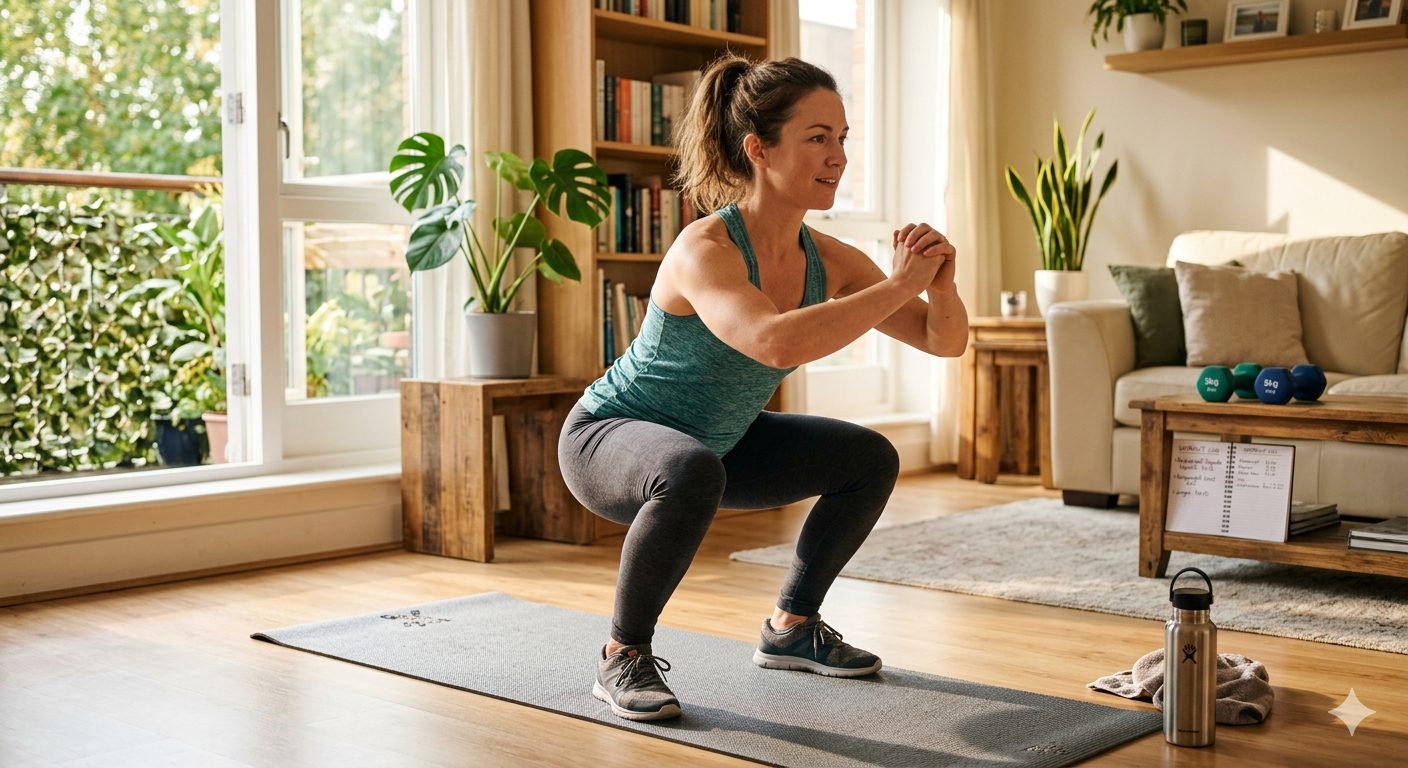
| Bodyweight squats | Legs, glutes | Keep chest up, knees over toes, go as deep as comfortable |
| Incline push-ups | Chest, shoulders, triceps | Hands on a sturdy table or couch. Body straight line from head to heels |
| Reverse lunges | Legs, glutes, balance | Step backward, lower until front thigh parallel to floor |
| Plank | Core, shoulders | Forearms on floor, body straight, squeeze glutes and abs |
| Glute bridges | Glutes, hamstrings | Squeeze glutes at top, lower with control |
| Bodyweight rows | Back, biceps | Under a sturdy table, pull chest to edge |
Cool-Down (5 minutes)
-
Hamstring stretch: 30 seconds each leg
-
Quad stretch: 30 seconds each leg
-
Chest stretch in doorway: 30 seconds
-
Child’s pose: 1 minute
How to Progress (Progressive Overload for Beginners)
When the routine feels easy, challenge yourself:
-
Add weight: Hold a backpack filled with books, or water bottles
-
Increase reps: Aim for 45 seconds work instead of 40
-
Increase sets: Do 4 rounds instead of 3
-
Decrease rest: Rest 15 seconds instead of 20
-
Advance the exercise:
-
Squat → Jump squat or Bulgarian split squat
-
Incline push-up → Knee push-up → Full push-up
-
Bodyweight row → Use a lower table (more horizontal)
-
Track your progress in a notebook. Write down how many rounds, how you felt, and what you want to improve next time.
Sample Weekly Schedule
| Day | Activity |
|---|---|
| Monday | Strength routine |
| Tuesday | Active recovery (walk, yoga, stretch) |
| Wednesday | Strength routine |
| Thursday | Cardio (walk, jog, bike, swim) |
| Friday | Strength routine |
| Saturday | Active recovery or fun movement |
| Sunday | Rest |
Frequently Asked Questions
Q: How long until I see results?
A: You may feel stronger within 2-4 weeks. Visible changes in muscle tone typically take 8-12 weeks of consistent training (2-3 times weekly). Fat loss depends on your nutrition.
Q: Will I get bulky if I lift heavy?
A: No. Women lack the testosterone for significant muscle size without dedicated bodybuilding protocols. Heavy lifting builds density and strength, not bulk.
Q: Do I need protein powder?
A: Not necessarily. You can get protein from food (eggs, chicken, fish, Greek yogurt, legumes, tofu). Protein powder is convenient if you struggle to meet your needs.
Q: How much protein do I need?
A: For muscle building, aim for 1.6-2.2 grams per kilogram of body weight. For a 150-pound (68 kg) woman, that’s about 109-150 grams daily.
Q: Can I do strength training every day?
A: Your muscles need recovery. Beginners should strength train 2-3 days weekly, with rest days in between. You can do cardio or active recovery on other days.
Q: I have bad knees. Can I still do squats?
A: Yes, but modify. Start with partial squats (only go as low as comfortable). Use a chair for support. Focus on glute bridges and leg raises. Consider seeing a physical therapist.
Q: What if I can’t do a full push-up?
A: Start with incline push-ups (hands on a wall, then a table, then a low couch). Progress gradually. Knee push-ups are also fine but don’t build as much core stability.
Q: Do I need to join a gym?
A: No. Bodyweight exercises are effective, especially for beginners. As you progress, you may want resistance bands, dumbbells, or a gym. But start where you are with what you have.
The Bottom Line
Strength training is for every woman. It doesn’t matter your age, fitness level, or body type. You won’t get bulky you’ll get capable.
You’ll carry groceries without strain. You’ll lift your kids or grandkids. You’ll walk up stairs without getting winded. You’ll stand taller, move easier, and feel more powerful in your own body.
Start where you are. Do what you can. Progress gradually. And remember: the strongest thing you can lift is your own self doubt.